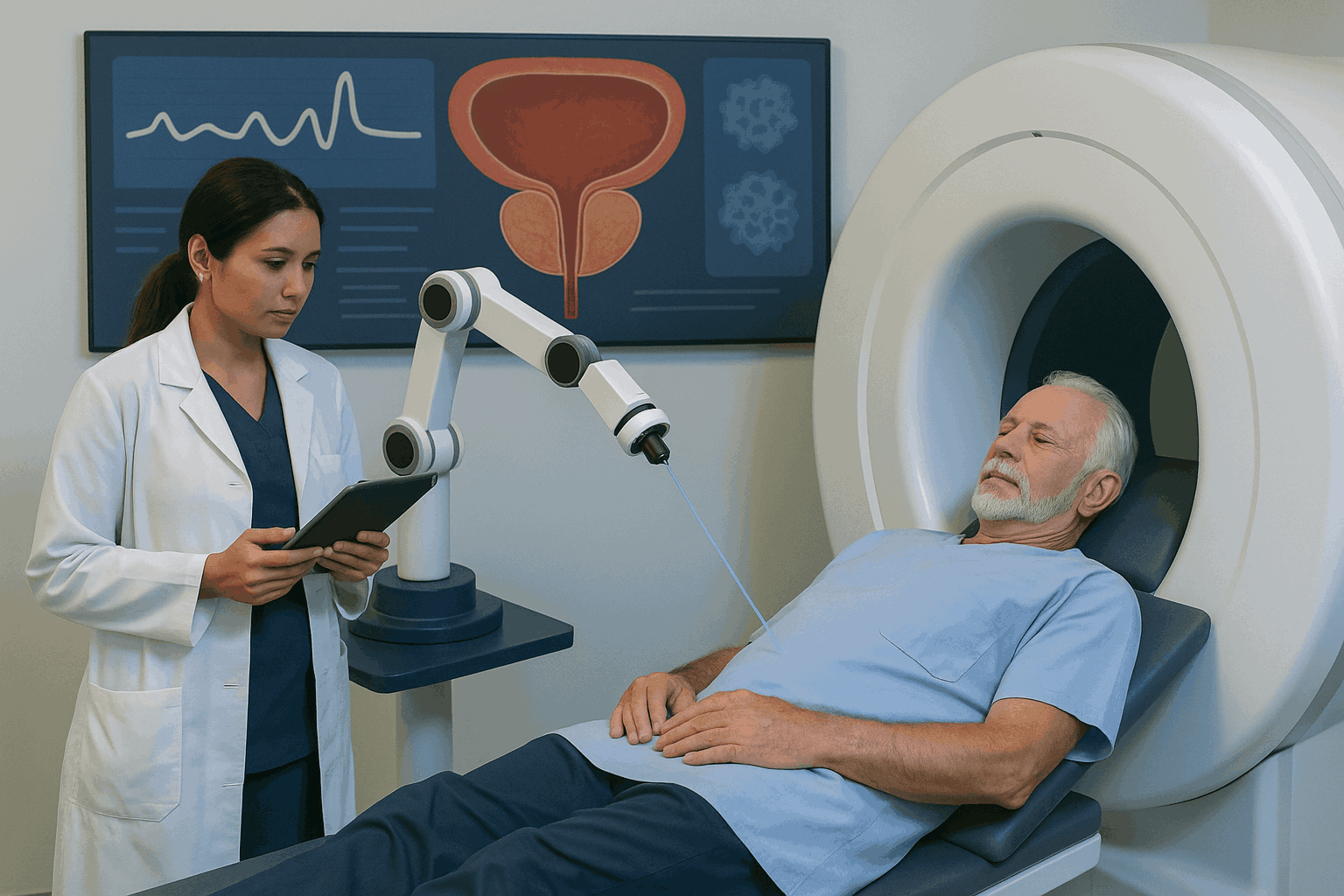
Prostate Health in 2025: A New Era of Precision and Hope
The year 2025 marks a turning point in how we understand and treat prostate cancer. With remarkable innovations—from personalized gene-targeted drugs to advanced imaging and minimally invasive therapies—the landscape of prostate cancer treatment is evolving rapidly.
At Medeor Hospital Abu Dhabi, our team of Urology Cancer Doctors, Urologists, and Radiologists work together to ensure that every patient receives cutting-edge care tailored to his unique condition and lifestyle.
Understanding the Prostate Gland and Its Importance
The prostate gland is a small, walnut-shaped organ located below the bladder and in front of the rectum. Its primary role is to produce seminal fluid that nourishes and protects sperm.
When this tiny gland faces issues—such as prostatitis, benign enlargement, or cancer—it can significantly impact urinary and reproductive health. These conditions often cause prostate symptoms or lower urinary tract symptoms (LUTS) such as:
- Frequent urination, especially at night
- Weak or interrupted urine flow
- Pain or burning during urination
- Blood in urine or semen
- Discomfort in the pelvic area or lower back
While many of these symptoms are benign, they can sometimes indicate prostate cancer, a disease that often develops silently in its early stages.
The Power of Early Detection: Modern Screening Techniques
1. PSA Test
The PSA test (Prostate-Specific Antigen test) remains one of the most valuable tools for early detection. Elevated PSA levels can be caused by prostatitis, benign enlargement, or cancer, so interpretation requires expertise. Our Urologists at Medeor Hospital Abu Dhabi assess your PSA results in combination with other risk factors to determine the next steps.
2. Prostate Exam
A prostate exam (Digital Rectal Exam) helps your doctor detect abnormalities in size, shape, or texture of the prostate. It’s a quick, essential test that complements the PSA.
3. Advanced Imaging by Radiologists
Modern imaging techniques have revolutionized detection. Radiologists now use Multiparametric MRI (mpMRI) to visualize suspicious areas before performing a prostate biopsy, improving accuracy, and minimizing unnecessary procedures.
In 2025, PSMA PET scans have become increasingly accessible, helping Urology Cancer Doctors pinpoint cancer spread and tailor treatments precisely.
4. Prostate Biopsy
If abnormalities are found, a prostate biopsy—often MRI-guided—is performed. This confirms whether cancer is present and how aggressive it is.
Breakthroughs in Prostate Cancer Treatment (2025)
1. PSMA Radioligand Therapy – Targeted Precision
In 2025, PSMA radioligand therapy (Lu-177-PSMA) has been approved for earlier use, even before chemotherapy, in PSMA-positive metastatic prostate cancer. This therapy delivers radiation directly to cancer cells while sparing healthy tissue, significantly improving outcomes and quality of life.
2. Genetic-Based Treatments for BRCA2 Prostate Cancer
Patients with BRCA2 prostate cancer—a hereditary form linked to DNA repair mutations—now benefit from PARP inhibitor therapy. When combined with modern hormonal treatments, PARP inhibitors block cancer’s ability to repair itself, stopping its growth.
3. Triplet Therapy for Advanced Cases
For men diagnosed with metastatic hormone-sensitive prostate cancer, triplet therapy—a combination of androgen deprivation therapy (ADT), chemotherapy, and next-generation hormone blockers—has become the gold standard.
4. Focal Therapy and Prostate Laser Treatment
Minimally invasive treatments like focal therapy and prostate laser treatment have advanced significantly. Instead of removing the entire prostate gland, these approaches precisely target cancerous tissue using high-intensity energy, such as HIFU (High-Intensity Focused Ultrasound) or laser ablation.
These techniques are ideal for small, localized cancers and offer shorter recovery, better urinary control, and reduced risk of sexual side effects. Our Radiologists assist in precise imaging, while Urology Cancer Doctors perform these state-of-the-art procedures at Medeor.
5. Precision Radiation Therapy
Modern radiation machines now allow image-guided and adaptive radiation therapy, which conforms to the tumor’s exact shape and motion. This advancement minimizes damage to nearby tissues and reduces complications.
6. Robotic and Laparoscopic Prostate Surgery
Prostate surgery has evolved into a far more precise and less invasive process. Robotic-assisted and laparoscopic techniques allow surgeons to remove cancer with minimal incisions, less bleeding, and faster recovery times.
Our skilled Urologists at Medeor Hospital Abu Dhabi specialize in such minimally invasive approaches, combining advanced technology with human expertise.
How 2025 is Changing Diagnosis and Care Pathways
- MRI-First Protocols: Using MRI before biopsy prevents unnecessary invasive procedures.
- Personalized Medicine: Genetic profiling determines which therapy works best for your tumor type.
- Integrated Care Teams: Collaboration among Urologists, Radiologists, oncologists, and pathologists ensures accuracy and precision at every stage.
- Real-Time Monitoring: AI-driven systems now help track PSA levels, imaging changes, and treatment response, allowing for early intervention when needed.
Androgen Deprivation Therapy (ADT): Reinvented
Androgen deprivation therapy—which lowers testosterone to slow cancer growth—remains vital. However, in 2025, new formulations and drug delivery systems have reduced side effects such as fatigue, bone loss, and mood changes.
At Medeor, supportive care includes bone-protective medications, exercise regimens, and dietary counseling to help patients maintain strength and vitality during ADT.
FAQs
Q1. What makes prostate cancer treatment in 2025 different?
Treatments are more precise and less invasive. Innovations like PSMA radioligand therapy, PARP inhibitors for BRCA2 prostate cancer, and prostate laser treatment offer better outcomes with fewer side effects.
Q2. How can I maintain good prostate health?
Schedule regular PSA tests and prostate exams, maintain a healthy weight, exercise, and eat a diet rich in fruits, vegetables, and omega-3s.
Q3. Are prostate symptoms always a sign of cancer?
Not always. Prostatitis or benign enlargement can cause similar symptoms. However, persistent lower urinary tract symptoms should never be ignored—always consult a Urologist.
Q4. What is PSMA radioligand therapy, and who qualifies for it?
It’s a therapy that delivers radioactive molecules directly to cancer cells expressing PSMA. Patients with PSMA-positive, advanced cancer are prime candidates after proper imaging by Radiologists.
Q5. Is prostate surgery still the main treatment?
Prostate surgery remains a key option for localized cancer, but newer treatments like focal therapy and precision radiation are offering alternatives for selected patients.
Q6. What’s new for men with BRCA2 prostate cancer?
Combination therapy with PARP inhibitors and hormonal agents now significantly improves survival for men with BRCA2 mutations.
Q7. Does a high PSA level always mean cancer?
No. High PSA can result from prostatitis or enlargement. Repeat testing and imaging help confirm the cause before a prostate biopsy.
Q8. How often should I get screened?
Men aged 50 and above—or 40 and above with a family history—should undergo annual PSA testing and prostate health evaluations.
Q9. How does a multidisciplinary team improve treatment?
Your Urology Cancer Doctors, Urologists, and Radiologists work together to analyze your scans, biopsy, and genetic data, ensuring you receive the right treatment at the right time.
Q10. Can prostate cancer be cured?
Yes—especially when detected early. Localized cancers have excellent cure rates with surgery, radiation, or focal therapy. Even advanced cases can be managed effectively with today’s advanced therapies.
Conclusion
In 2025, the future of prostate cancer treatment is defined by precision, personalization, and compassion. From PSMA radioligand therapy and androgen deprivation therapy advancements to prostate laser treatment, genetic testing for BRCA2 prostate cancer, and robotic prostate surgery, patients now have more options—and more hope—than ever before.
At Medeor Hospital Abu Dhabi, our integrated team of Urology Cancer Doctors, Urologists, and Radiologists ensures every patient benefits from world-class diagnostic tools and cutting-edge therapies under one roof.
Whether you’re here for a simple PSA test, a detailed prostate exam, or advanced treatment planning, we’re committed to guiding you every step of the way—with expertise, empathy, and innovation.
Prioritize your prostate health today!
If you’re experiencing urinary symptoms or are due for your screening, book your consultation at Medeor Hospital Abu Dhabi.
Your health deserves the best—and at Medeor, you’ll find the most advanced care for prostate health in 2025.